Watch the 4-minute video
4:10 · English · Fictional examples. The video loads from YouTube only when you press play. Watch on YouTube
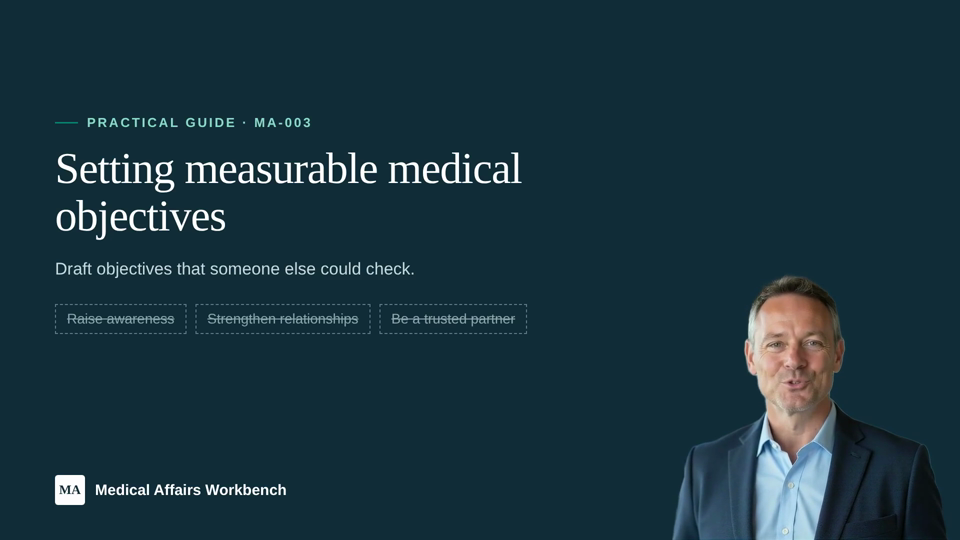
Most medical plans contain objectives. Fewer contain objectives that someone else could check at the end of the year. “Raise awareness of the disease area”, “strengthen relationships with key experts” and “be a trusted scientific partner” describe good intentions, but none of them says what will be different, how anyone would know, or by when.
This article sets out a practical way to draft medical objectives that can be checked: start from the medical need, choose and define a measure, record a baseline and a target, check the draft before it is agreed, and review progress against evidence. Each step matches a tab of the Medical Objective Drafting Worksheet.
Why many medical objectives cannot be checked
Intentions are not objectives
Goal-setting research summarised by Locke and Latham found that when people are asked simply to do their best, they generally do not, because a vague goal leaves the acceptable level of performance open to interpretation. [2] The same applies to a team: an objective without a defined result gives no shared reference point for planning or review.
Activity counts show effort, not results
Counting visits, meetings or symposia is easy, and these counts have a place in managing workload. They are outputs. The logic model guide published by the W.K. Kellogg Foundation describes outputs as the direct results of programme activities, and outcomes as specific changes in attitudes, behaviours, knowledge, skills, status or level of functioning. [4] An objective that names only an output can be fully met while the medical need it was meant to address is unchanged. Speakers at a Medical Affairs Professional Society (MAPS) webinar on medical KPIs made a similar point: volume and value combined give a more useful picture than volume alone. [5]
Start from the medical need
Write the need before the objective
Begin with the medical need or scientific question the objective is meant to address, such as an evidence gap, a recurring clinical question or a knowledge need identified through insights. Writing it first keeps the objective tied to a reason, and makes it easier to see later whether the objective addressed it. For this reason the worksheet places the Medical need or question column before the Objective statement.
Keep the objective within the medical remit
Medical objectives should describe medical and scientific outcomes, such as evidence reviewed, questions answered or knowledge needs addressed. Do not set sales, prescribing or market-share targets as medical objectives. Company policies and local codes define where the boundaries lie, so check them and use the approved review process.
The examples below are fictional. They show how an intention becomes an objective that can be checked.
| Intention | Medical need | Checkable objective |
|---|---|---|
| “Raise awareness of monitoring in long-term follow-up” | Specialists report uncertainty about how to monitor patients during long-term follow-up. | Complete a structured review of published monitoring evidence and share a reviewed summary with the regional medical team by 15 December 2026. |
| “Be a trusted partner on diagnostics” | Field insights suggest varied understanding of local diagnostic guidance. | Increase the share of logged diagnostic questions resolved with reviewed evidence from 20% to 50% by 30 June 2027. |
| “Support evidence generation” | Field insights point to an unanswered question on real-world treatment sequencing. | Assess whether the highest-priority sequencing question can be answered with an existing data source, with a reviewed recommendation by 31 March 2027. |
Choose a measure, and define it
Outputs or outcomes
Some objectives are best measured by a defined output, such as a reviewed evidence summary or a completed feasibility assessment. Others aim at an outcome, such as a change in the questions clinicians ask. Outcomes are closer to what matters, but they are harder to measure and often depend on factors outside the team’s control. Either can be appropriate. What matters is that the choice is deliberate and the measure fits the objective.
Write how it is counted
A measure named in two words, such as “questions resolved”, is open to interpretation. Write down what counts, what does not, over what period, and whether the result is a number, a percentage or a yes or no. Name the data source and check that the team can actually access it before the objective is agreed. The MAPS speakers recommended defining metrics at the start, not retrospectively. [5]
Record the baseline and the target
A target needs a starting point
A target of 50% means little unless the current value is known. Record the baseline value and the date it applies to. If the measure is new and no baseline exists, record that, together with when the first measurement will be taken, rather than leaving the field blank.
Set a target and a date
Locke and Latham reported that specific, difficult goals led to higher performance than vague goals, and that the relationship is strongest when people are committed to the goal. [2] For a medical team, a sensible target is one the team can influence with the resources it has and is willing to commit to. Add a target date, and a review date before it, so there is time to adjust.
Check quality before agreeing
SMART objectives: a useful checklist, with limits
Doran’s 1981 article introduced the SMART acronym as a way to write management goals and objectives. [1] It is widely used, but a critical review by Swann and colleagues concluded that the acronym lacks a strong theoretical and empirical foundation and is applied inconsistently. [3] Use it as a prompt, not as proof that an objective is sound.
Seven questions for a draft objective
The Quality Check tab of the worksheet asks the seven questions below. A Yes to all seven means the objective is complete and checkable. It does not mean it is the right objective; that remains a judgement for the team.
| Question | Why it matters | Fictional example (OBJ-001) |
|---|---|---|
| 1. Is the medical need stated? | Links the objective to a reason, so the team can later check whether the need was addressed. | Uncertainty about monitoring in long-term follow-up |
| 2. Is the measure clearly defined? | Prevents different people counting different things. | Complete when the summary is approved through medical review |
| 3. Is the baseline recorded, or the reason it is missing? | Without a starting point, change cannot be shown. | No summary available (1 October 2026) |
| 4. Is the data source available? | A measure that cannot be collected cannot be reviewed. | Medical review record |
| 5. Is the time frame stated? | Sets when the objective will be judged and when to review it. | Target 15 December 2026; review 15 November 2026 |
| 6. Is an owner named? | Someone is accountable for progress and for keeping the record up to date. | Medical Lead A |
| 7. Is it within the medical remit, with no sales or promotional targets? | Keeps the objective consistent with the role of Medical Affairs and with company policy. | Evidence review and summary only |
Review progress with evidence
Review on a regular cycle
Locke and Latham noted that, for goals to be effective, people need feedback that shows progress in relation to them. [2] Agree a review rhythm, such as monthly or quarterly. At each review, record the value observed and the document that shows it in the Progress Log. The Objectives tab then shows the latest value and its date.
Mark an objective achieved only with evidence
An objective is achieved when the evidence named in the plan shows that the target was met, not when the planned activities were completed. The worksheet flags an objective marked Achieved when no evidence of progress is recorded. If the need changes, mark the objective Revised or Stopped and note why, rather than rewriting the original objective.
Keep confidential information out
Do not record patient identifiers, adverse event or product complaint details, or confidential company information in the worksheet. Handle those through the organisation’s approved processes and systems.
Before agreeing an objective
• Is the medical need or question written down?
• Could someone outside the team tell whether the objective was met?
• Is the measure defined, and is its data source available?
• Are the baseline and its date recorded, or the reason one is missing?
• Is there a target, a target date and a review date?
• Is the objective free of sales, prescribing and market-share targets?
• Is an owner named?
Related reading: What is Medical Affairs? (Basics guide) · Building a scientific engagement plan
References
1. Doran GT. There’s a S.M.A.R.T. way to write management’s goals and objectives. Management Review. 1981;70(11):35–36. Source of the SMART acronym.
2. Locke EA, Latham GP. Building a practically useful theory of goal setting and task motivation: a 35-year odyssey. American Psychologist. 2002;57(9):705–717. Sections on goal specificity and difficulty, commitment and feedback.
3. Swann C, Jackman PC, Lawrence A, Hawkins RM, Goddard SG, Williamson O, Schweickle MJ, Vella SA, Rosenbaum S, Ekkekakis P. The (over)use of SMART goals for physical activity promotion: a narrative review and critique. Health Psychology Review. 2023;17(2):211–226.
4. W.K. Kellogg Foundation. Logic Model Development Guide: Using Logic Models to Bring Together Planning, Evaluation, and Action. Battle Creek, MI: W.K. Kellogg Foundation; updated January 2004. Definitions of outputs and outcomes.
5. Medical Affairs Professional Society. Communicating the Value & Measuring the Impact of Medical Affairs Functions: Medical Key Performance Indicators (KPIs) & Dashboards. Webinar slides, 2021.
Sources accessed 22 October 2026. The references support the cited principles. The seven quality questions, the review steps and the worksheet design are practical guidance prepared for this article, not validated tools. All examples are fictional. Companion file: Medical Objective Drafting Worksheet version 1.0, catalogue ID MA-003.
Missing something? Tell us which topic, tool or guide you would like next. We read every suggestion. Suggest a topic or tool
Medical Objective Drafting Worksheet
Explore the workbook, its instructions and its fictional examples before adapting it to your team.
View the matching workbook